I am not married and my period comes regularly every month. But my
problem is that it starts off yellow, tinged with beige and brown, and
sometimes goes on for three or four days with pain in the lower
abdomen, intense agitation and bad mood. Then it becomes black for one
or two days at the most, then red blood comes for between five and
seven days, then it goes back to a brown colour, then yellow, then
after one or two days of the yellow discharge, sometimes there is a
white discharge, the sign of purity (end of the period), or sometimes
the yellow discharge continues until the next period, i.e., it lasts
for a month.
My question is: when should I pray and when should I stop praying?
When should I fast and when should I not fast?
Praise be to Allah.
Firstly:
The yellowish or brownish discharge that precedes the blood is not
regarded as the menses; the same applies to that which comes after
seeing the white discharge (that signals the end of the period),
because Umm Salamah (may Allah be pleased with her) said: "We used not
to regard the yellowish brownish discharge after the white discharge
(that signals the end of the period) as being of any significance."
Narrated by Abu Dawood, 307; classed as saheeh by al-Albaani inIrwa'
al-Ghaleel, 199
With regard to yellowish and brownish discharge that comes after the
bleeding and before the white discharge (that signals the end of the
period), this is regarded as menses, because of the report narrated by
Maalik inal-Muwatta', 130, from Umm Salamah, according to which she
said: The women used to send to 'Aa'ishah, the Mother of the
Believers, small vessels containing the pieces of cotton on which
there were yellowish traces from the menstrual blood, and they would
ask her about praying, and she would say to them: Do not be hasty
until you see the white discharge, referring to that which signals the
end of the period.
This was also narrated by al-Bukhaari in a mu'allaq report (Kitaab
al-Hayd, Baab iqbaal al-Maheed wa idbaarihi; classed as saheeh by
al-Albaani inIrwa' al-Ghaleel, 198
Based on that, the yellowish or brownish discharge that lasts for
three or four days before the bleeding starts is not regarded as
menses, and you should not stop praying or fasting at that time.
The black blood and the red blood that comes after it, and the
yellowish discharge, are menses, until you see the white discharge or
complete dryness.
If you see the white discharge or complete dryness, any discharge
after that, yellowish or brownish, is not regarded as menses.
Please see questions no. 171945, 157020and 82507
Secondly:
If the red blood continues, or the yellowish or brownish discharge
that come after it, before the white discharge or complete dryness
appear – if that goes on for longer than fifteen days, then you
aremustahaadah(i.e., experiencingistihaadahor irregular, non-menstrual
bleeding), according to the majority of scholars. Some scholars say
that istihaadah cannot be proven unless that continues for the entire
month or for the entire month apart from two or three days. This is
the view favoured by Shaykh al-Islam Ibn Taymiyah and those who
followed him and those who do not think there is any maximum length
for the menses, and their view is closer to the apparent meaning of
the evidence.
If it becomes clear that you are experiencing istihaadah, then in the
following months you should act in accordance with your cycle as it
was in the past. So you should stop praying and so on for the duration
of bleeding, until the appearance of the white discharge (signalling
the end of the period) that you mentioned in your question, then you
should do ghusl. For example, if your period, before experiencing
istihaadah, used to last for ten days, then you should do ghusl after
the tenth day, and do wudoo' at the time of each prayer.
A woman who did not have a regular cycle before experiencing
istihaadah should base her actions on differentiating between
different kinds of bleeding. This has been explained in the answer to
question no. 68818
Our advice to you is to consult a specialist doctor for treatment of
these ongoing discharges.
And Allah knows best.
"GENERAL ARTICLES"
- Tamil -- Urdu -- Kannada -- Telugu --*-
 Share Share
-
-*-
Share Share
-
-*- 


 *: ::->
*
*: ::->
*
"BISMILLA HIRRAHMAAN NIRRAHEEM"
WELCOME! - AS'SALAMU ALAIKUM!!
******** *****
*****
[All] praise is [due] to Allah, Lord of the worlds; -
Guide us to the straight path
*- -*

* * In this Blog; More Than Ten Thousand(10,000) {Masha Allah} - Most Usefull Articles!, In Various Topics!! :- Read And All Articles & Get Benifite!
* Visit :- 

*- WHAT ISLAM SAYS -*
-
Islam is a religion of Mercy, Peace and Blessing. Its teachings emphasize kind hear tedness, help, sympathy, forgiveness, sacrifice, love and care.Qur’an, the Shari’ah and the life of our beloved Prophet (SAW) mirrors this attribute, and it should be reflected in the conduct of a Momin.Islam appreciates those who are kind to their fellow being,and dislikes them who are hard hearted, curt, and hypocrite.Recall that historical moment, when Prophet (SAW) entered Makkah as a conqueror. There was before him a multitude of surrendered enemies, former oppressors and persecutors, who had evicted the Muslims from their homes, deprived them of their belongings, humiliated and intimidated Prophet (SAW) hatched schemes for his murder and tortured and killed his companions. But Prophet (SAW) displayed his usual magnanimity, generosity, and kind heartedness by forgiving all of them and declaring general amnesty...Subhanallah. May Allah help us tailor our life according to the teachings of Islam. (Aameen)./-
| ''HASBUNALLAHU WA NI'MAL WAKEEL''
-
''Allah is Sufficient for us'' + '' All praise is due to Allah. May peace and blessings beupon the Messenger, his household and companions '' (Aameen)  '' Our Lord ! grant us good in this world and good in the hereafter and save us from the torment of the Fire '' [Ameen]
-
{in Arab} :->
Rabbanaa aatinaa fid-dunyaa hasanatan wafil aakhirati hasanatan waqinaa 'athaaban-naar/-
(Surah Al-Baqarah ,verse 201)*--*~
'' Our Lord ! grant us good in this world and good in the hereafter and save us from the torment of the Fire '' [Ameen]
-
{in Arab} :->
Rabbanaa aatinaa fid-dunyaa hasanatan wafil aakhirati hasanatan waqinaa 'athaaban-naar/-
(Surah Al-Baqarah ,verse 201)*--*~
| | |
| | | |
          
|
Share
Follow Me | |
Share
**
Share
-
-*-
Monday, October 14, 2013


Dought & clear, - Etiquette of Eid
What are the Sunnahs and etiquettes that we should act in accordance
with on the day of Eid?.
Praise be to Allaah.
The Sunnahs that the Muslim should observe on the day of Eid are as follows:
1 – Doing ghusl before going out to the prayer.
It was narrated in a saheeh hadeeth inal-Muwatta'and elsewhere that
'Abd-Allaah ibn 'Umar used to do ghusl on the day of al-Fitr before
going out to the prayer-place in the morning.Al-Muwatta'428.
Al- Nawawi (may Allaah have mercy on him) said that the Muslims were
unanimously agreed that it is mustahabb to do ghusl for Eid prayer.
The reason why it is mustahabb is the same reason as that for doing
ghusl before Jumu'ah and other public gatherings. Rather on Eid the
reason is even stronger.
2 – Eating before going out to pray on Eid al-Fitr and after the
prayer on Eid al-Adha:
Part of the etiquette is not to go out to pray on Eid al-Fitr until
one has eaten some dates, because of the hadeeth narrated by
al-Bukhaari from Anas ibn Maalik, who said that the Messenger of
Allaah(peace and blessings of Allaah be upon him) used not to go out
on the morning of Eid al-Fitr until he had eaten some dates… of which
he would eat an odd number. Al-Bukhaari, 953.
It is mustahabb to eat before going out to emphasize the fact that it
is forbidden to fast on that day and to demonstrate that the fast has
ended.
Ibn Hajar (may Allaah have mercy on him) suggested that the reason for
that was so as to ward off the possibility of adding to the fast, and
to hasten to obey the command of Allaah.Al-Fath, 2/446
Whoever does not have any dates may break his fast with anything that
is permissible.
But on Eid al-Adha it is mustahabb not to eat anything until one comes
back from the prayer, so he should eat from the udhiyah if he has
offered a sacrifice. If he is not going to offer a sacrifice there is
nothing wrong with eating before the prayer.
3 – Takbeer on the day of Eid
This is one of the greatest Sunnahs on the day of Eid because Allaah
says (interpretation of the meaning):
"(He wants that you) must complete the same number (of days), and that
you must magnify Allaah [i.e. to say Takbeer (Allaahu Akbar: Allaah is
the Most Great)] for having guided you so that you may be grateful to
Him"
[al-Baqarah 2:185]
It was narrated that al-Waleed ibn Muslim said: I asked al-Awzaa'i and
Maalik ibn Anas about saying Takbeer out loud on the two Eids. They
said, Yes, 'Abd-Allaah ibn 'Umar used to say it out loud on the day of
al-Fitr until the imam came out (to lead the prayers).
It was narrated in a saheeh report that 'Abd al-Rahmaan al-Sulami
said, "They emphasized it more on the day of al-Fitr than the day of
al-Adha.". Wakee' said, this refers to the takbeer. SeeIrwa'
al-Ghaleel, 3/122/
Al-Daaraqutni and others narrated that on the morning of Eid al-Fitr
and Eid al-Adha, Ibn 'Umar would strive hard in reciting takbeer until
he came to the prayer place, then he would recite takbeer until the
imam came out.
Ibn Abi Shaybah narrated with a saheeh isnaad that al-Zuhri said: The
people used to recite Takbeer on Eid when they came out of their
houses until they came to the prayer place, and until the imam came
out. When the imam came out they fell silent, and when he said takbeer
they said takbeer. SeeIrwa' al-Ghaleel, 1/121
Saying takbeer when coming out of one's house to the prayer place and
until the imam came out was something that was well known among the
salaf (early generations). This has been narrated by a number of
scholars such as Ibn Abi Shaybah, 'Abd a l-Razzaaq and al-Firyaabi
inAhkaam al-Eidaynfrom a group of the salaf. For example, Naafi' ibn
Jubayr used to recite takbeer and was astonished that the people did
not do so, and he said, "Why do you not recite takbeer?"
Ibn Shihaab al-Zuhri (may Allaah have mercy on him) used to say, "The
people used to recite takbeer from the time they came out of their
houses until the imam came in."
The time for takbeer on Eid al-Fitr starts from the night before Eid
until the imam enters to lead the Eid prayer.
In the case of Eid al-Adha, the takbeer begins on the first day of
Dhu'l-Hijjah and lasts until sunset on the last of the days of
tashreeq.
Description of the takbeer:
It was narrated in the Musannaf of Ibn Abi Shaybah with a saheeh
isnaad from Ibn Mas'ood (may Allaah be pleased with him) that he used
to recite takbeer during the days of tashreeq:
Allaahu akbar, Allaahu akbar, laa ilaaha ill-Allaah, wa Allaahu akbar,
Allaah akbar, wa Lillaah il-hamd(Allaah is Most Great, Allaah is most
Great, there is no god but Allaah, Allaah is Most great, Allaah is
most great, and to Allaah be praise).
It was also narrated elsewhere by Ibn Abi Shaybah with the same
isnaad, but with the phrase "Allaahu akbar" repeated three times.
Al-Mahaamili narrated with a saheeh isnaad also from Ibn Mas'ood:
"Allaahu akbaru kabeera, Allaahu akbaru kabeera, Allaahu akbar wa
ajallu, Allaahu akbar wa Lillaah il-hamd(Allaah is Most Great indeed,
Allaah is Most Great indeed, Allaah is most Great and Glorified,
Allaah is Most Great and to Allaah be praise)." Seeal-Irwa', 3/126.
4 – Offering congratulations
The etiquette of Eid also includes the congratulations and good wishes
exchanged by people, no matter what the wording, such as saying to one
anotherTaqabbala Allaah minna wa minkum(May Allaah accept (good deeds)
from us and from you" or "Eid mubaarak" and other permissible
expressions of congratulations.
It was narrated that Jubayr ibn Nufayr said: When the companions of
the Prophet(peace and blessings of Allaah be upon him) met one another
on the day of Eid, they would say to one another, "May Allaah accept
(good deeds) from us and from you." Ibn Hajar said, its isnaad is
hasan.Al-Fath, 2/446.
Offering congratulations was something that was well known among the
Sahaabah, and scholars such as Imam Ahmad and others allowed it. There
is evidence which suggests that it is prescribed to offer
congratulations and good wishes on special occasions, and that the
Sahaabah congratulated one another when good things happened, such as
when Allaah accepted the repentance of a man, they went and
congratulated him for that, and so on.
Undoubtedly these congratulations are among the noble characteristics
among the Muslims.
The least that may be said concerning the subject of congratulations
is that you should return the greetings of those who congratulate you
on Eid, and keep quiet if others keep quiet, as Imam Ahmad (may Allaah
have mercy on him) said: If anyone congratulates you, then respond,
otherwise do not initiate it.
5 – Adorning oneself on the occasion of Eid.
It was narrated that 'Abd-Allaah ibn 'Umar (may Allaah be pleased with
him) said that 'Umar took a brocade cloak that was for sale in the
market and brought it to the Messenger of Allaah(peace and blessings
of Allaah be upon him), and said, "O Messenger of Allaah, buy this and
adorn yourself with it for Eid and for receiving the delegations." The
Messenger of Allaah(peace and blessings of Allaah be upon him) said to
him, "Rather this is the dress of one who has no share (of piety or of
reward in the Hereafter)…" Narrated by al-Bukhaari, 948.
The Prophet(peace and blessings of Allaah be upon him) agreed with
'Umar on the idea of adorning oneself for Eid, but he denounced him
for choosing this cloak because it was made of silk.
It was narrated that Jaabir (may Allaah be pleased with him) said: The
Prophet(peace and blessings of Allaah be upon him) had a cloak which
he would wear on the two Eids and on Fridays.Saheeh Ibn Khuzaymah,
1756,
Al-Bayhaqi narrated with a saheeh isnaad that Ibn 'Umar used to wear
his best clothes on Eid.
So a man should wear the best clothes that he has when going out for Eid.
With regard to women, they should avoid adorning themselves when they
go out for Eid, because they are forbidden to show off their
adornments to non-mahram men. It is also haraam for a woman who wants
to go out to put on perfume or to expose men to temptation, because
they are only going out for the purpose of worship.
6 – Going to the prayer by one route and returning by another.
It was narrated that Jaabir ibn 'Abd-Allaah (may Allaah be pleased
with him) said: On the day of Eid, the Prophet(peace and blessings of
Allaah be upon him) used to vary his route. Narrated by al-Bukhaari,
986.
It was said that the reason for that was so that the two routes would
testify for him on the Day of Resurrection, for the earth will speak
on the Day of Resurrection and say what was done on it, both good and
bad.
And it was said that it was in order to manifest the symbols of Islam
on both routes, or to manifest the remembrance of Allaah (dhikr), or
to annoy the hypocrites and Jews, and to scare them with the large
number of people who were with him. And it was said that it was in
order to attend to the people's needs, to answer their questions,
teach them, set an example and give charity to the needy, or to visit
his relatives and uphold the ties of kinship.
And Allaah knows best.
with on the day of Eid?.
Praise be to Allaah.
The Sunnahs that the Muslim should observe on the day of Eid are as follows:
1 – Doing ghusl before going out to the prayer.
It was narrated in a saheeh hadeeth inal-Muwatta'and elsewhere that
'Abd-Allaah ibn 'Umar used to do ghusl on the day of al-Fitr before
going out to the prayer-place in the morning.Al-Muwatta'428.
Al- Nawawi (may Allaah have mercy on him) said that the Muslims were
unanimously agreed that it is mustahabb to do ghusl for Eid prayer.
The reason why it is mustahabb is the same reason as that for doing
ghusl before Jumu'ah and other public gatherings. Rather on Eid the
reason is even stronger.
2 – Eating before going out to pray on Eid al-Fitr and after the
prayer on Eid al-Adha:
Part of the etiquette is not to go out to pray on Eid al-Fitr until
one has eaten some dates, because of the hadeeth narrated by
al-Bukhaari from Anas ibn Maalik, who said that the Messenger of
Allaah(peace and blessings of Allaah be upon him) used not to go out
on the morning of Eid al-Fitr until he had eaten some dates… of which
he would eat an odd number. Al-Bukhaari, 953.
It is mustahabb to eat before going out to emphasize the fact that it
is forbidden to fast on that day and to demonstrate that the fast has
ended.
Ibn Hajar (may Allaah have mercy on him) suggested that the reason for
that was so as to ward off the possibility of adding to the fast, and
to hasten to obey the command of Allaah.Al-Fath, 2/446
Whoever does not have any dates may break his fast with anything that
is permissible.
But on Eid al-Adha it is mustahabb not to eat anything until one comes
back from the prayer, so he should eat from the udhiyah if he has
offered a sacrifice. If he is not going to offer a sacrifice there is
nothing wrong with eating before the prayer.
3 – Takbeer on the day of Eid
This is one of the greatest Sunnahs on the day of Eid because Allaah
says (interpretation of the meaning):
"(He wants that you) must complete the same number (of days), and that
you must magnify Allaah [i.e. to say Takbeer (Allaahu Akbar: Allaah is
the Most Great)] for having guided you so that you may be grateful to
Him"
[al-Baqarah 2:185]
It was narrated that al-Waleed ibn Muslim said: I asked al-Awzaa'i and
Maalik ibn Anas about saying Takbeer out loud on the two Eids. They
said, Yes, 'Abd-Allaah ibn 'Umar used to say it out loud on the day of
al-Fitr until the imam came out (to lead the prayers).
It was narrated in a saheeh report that 'Abd al-Rahmaan al-Sulami
said, "They emphasized it more on the day of al-Fitr than the day of
al-Adha.". Wakee' said, this refers to the takbeer. SeeIrwa'
al-Ghaleel, 3/122/
Al-Daaraqutni and others narrated that on the morning of Eid al-Fitr
and Eid al-Adha, Ibn 'Umar would strive hard in reciting takbeer until
he came to the prayer place, then he would recite takbeer until the
imam came out.
Ibn Abi Shaybah narrated with a saheeh isnaad that al-Zuhri said: The
people used to recite Takbeer on Eid when they came out of their
houses until they came to the prayer place, and until the imam came
out. When the imam came out they fell silent, and when he said takbeer
they said takbeer. SeeIrwa' al-Ghaleel, 1/121
Saying takbeer when coming out of one's house to the prayer place and
until the imam came out was something that was well known among the
salaf (early generations). This has been narrated by a number of
scholars such as Ibn Abi Shaybah, 'Abd a l-Razzaaq and al-Firyaabi
inAhkaam al-Eidaynfrom a group of the salaf. For example, Naafi' ibn
Jubayr used to recite takbeer and was astonished that the people did
not do so, and he said, "Why do you not recite takbeer?"
Ibn Shihaab al-Zuhri (may Allaah have mercy on him) used to say, "The
people used to recite takbeer from the time they came out of their
houses until the imam came in."
The time for takbeer on Eid al-Fitr starts from the night before Eid
until the imam enters to lead the Eid prayer.
In the case of Eid al-Adha, the takbeer begins on the first day of
Dhu'l-Hijjah and lasts until sunset on the last of the days of
tashreeq.
Description of the takbeer:
It was narrated in the Musannaf of Ibn Abi Shaybah with a saheeh
isnaad from Ibn Mas'ood (may Allaah be pleased with him) that he used
to recite takbeer during the days of tashreeq:
Allaahu akbar, Allaahu akbar, laa ilaaha ill-Allaah, wa Allaahu akbar,
Allaah akbar, wa Lillaah il-hamd(Allaah is Most Great, Allaah is most
Great, there is no god but Allaah, Allaah is Most great, Allaah is
most great, and to Allaah be praise).
It was also narrated elsewhere by Ibn Abi Shaybah with the same
isnaad, but with the phrase "Allaahu akbar" repeated three times.
Al-Mahaamili narrated with a saheeh isnaad also from Ibn Mas'ood:
"Allaahu akbaru kabeera, Allaahu akbaru kabeera, Allaahu akbar wa
ajallu, Allaahu akbar wa Lillaah il-hamd(Allaah is Most Great indeed,
Allaah is Most Great indeed, Allaah is most Great and Glorified,
Allaah is Most Great and to Allaah be praise)." Seeal-Irwa', 3/126.
4 – Offering congratulations
The etiquette of Eid also includes the congratulations and good wishes
exchanged by people, no matter what the wording, such as saying to one
anotherTaqabbala Allaah minna wa minkum(May Allaah accept (good deeds)
from us and from you" or "Eid mubaarak" and other permissible
expressions of congratulations.
It was narrated that Jubayr ibn Nufayr said: When the companions of
the Prophet(peace and blessings of Allaah be upon him) met one another
on the day of Eid, they would say to one another, "May Allaah accept
(good deeds) from us and from you." Ibn Hajar said, its isnaad is
hasan.Al-Fath, 2/446.
Offering congratulations was something that was well known among the
Sahaabah, and scholars such as Imam Ahmad and others allowed it. There
is evidence which suggests that it is prescribed to offer
congratulations and good wishes on special occasions, and that the
Sahaabah congratulated one another when good things happened, such as
when Allaah accepted the repentance of a man, they went and
congratulated him for that, and so on.
Undoubtedly these congratulations are among the noble characteristics
among the Muslims.
The least that may be said concerning the subject of congratulations
is that you should return the greetings of those who congratulate you
on Eid, and keep quiet if others keep quiet, as Imam Ahmad (may Allaah
have mercy on him) said: If anyone congratulates you, then respond,
otherwise do not initiate it.
5 – Adorning oneself on the occasion of Eid.
It was narrated that 'Abd-Allaah ibn 'Umar (may Allaah be pleased with
him) said that 'Umar took a brocade cloak that was for sale in the
market and brought it to the Messenger of Allaah(peace and blessings
of Allaah be upon him), and said, "O Messenger of Allaah, buy this and
adorn yourself with it for Eid and for receiving the delegations." The
Messenger of Allaah(peace and blessings of Allaah be upon him) said to
him, "Rather this is the dress of one who has no share (of piety or of
reward in the Hereafter)…" Narrated by al-Bukhaari, 948.
The Prophet(peace and blessings of Allaah be upon him) agreed with
'Umar on the idea of adorning oneself for Eid, but he denounced him
for choosing this cloak because it was made of silk.
It was narrated that Jaabir (may Allaah be pleased with him) said: The
Prophet(peace and blessings of Allaah be upon him) had a cloak which
he would wear on the two Eids and on Fridays.Saheeh Ibn Khuzaymah,
1756,
Al-Bayhaqi narrated with a saheeh isnaad that Ibn 'Umar used to wear
his best clothes on Eid.
So a man should wear the best clothes that he has when going out for Eid.
With regard to women, they should avoid adorning themselves when they
go out for Eid, because they are forbidden to show off their
adornments to non-mahram men. It is also haraam for a woman who wants
to go out to put on perfume or to expose men to temptation, because
they are only going out for the purpose of worship.
6 – Going to the prayer by one route and returning by another.
It was narrated that Jaabir ibn 'Abd-Allaah (may Allaah be pleased
with him) said: On the day of Eid, the Prophet(peace and blessings of
Allaah be upon him) used to vary his route. Narrated by al-Bukhaari,
986.
It was said that the reason for that was so that the two routes would
testify for him on the Day of Resurrection, for the earth will speak
on the Day of Resurrection and say what was done on it, both good and
bad.
And it was said that it was in order to manifest the symbols of Islam
on both routes, or to manifest the remembrance of Allaah (dhikr), or
to annoy the hypocrites and Jews, and to scare them with the large
number of people who were with him. And it was said that it was in
order to attend to the people's needs, to answer their questions,
teach them, set an example and give charity to the needy, or to visit
his relatives and uphold the ties of kinship.
And Allaah knows best.
For children, - Know your Master the Awaited One: Imam Mahdi (as)

of the age and the master of Earth before Doomsday.
He is the Savior of humanity, the Disposer of justice, the Proof of
God, the Awaited One, and the Heir of the Bible, the Torah, the Noble
Qur'an and all other heavenly books.
He is none other than the 12th and last apostle (Imam) after Prophet
Mohammed (SAW). He has many other titles, among them is also the
Guided One (Al-Mahdi in Arabic). His name is Mohammed son of Imam
Hassan Askari (as). He was born in Samarra (Iraq) on Friday 15th of
the month of Shabaanin 255 AH.
His father our 11th Imam, Imam Hassan Askari (as), was imprisoned
most of his life by Abbasid Caliphs to prevent him from having a son
whom they feared will bring the justice and equity that was promised
and remove tyranny and tyrants from the face of the earth. The 11th
Imam, Imam Hassan Askari (as) was poisoned in prison at the age of 28
in the year 260 AH by Al-Mu'tamid, the Abbasid Caliph.
The Awaited One, the 12th Imam, Imam Mahdi (as) is the only son of his
father, and he was 5 years old at the time of his father's death. His
mother was Nargis Khatoon (sa), for whom this article is being
dedicated.
Nargis Khatoon (sa), the Mother of Imam Mahdi (as) was a Roman
princess. She was the most pure offspring of the then European nations
and races. It was destined that Nargis Khatoon (sa) would go to the
streets of Baghdad to become owned by the most pure of men, the 11th
Imam, Imam Hassan Askari (as) and become the mother of the 12th Imam,
Imam Mahdi (as).
The story of how they met and joined is recorded in many history books
as well as sparsely in the scriptures of holy traditions of the
infallibles (the Prophet Mohammad (SAW), his daughter Fatima (sa) and
the twelve Imams (apostles)). It is in fact a most amazing love
storyin history.
This love story would also give a glimpse of the personality of the
offspring of their holy marriage, the master of the world, the
Anointed One, the twelfth Imam. So to know better our master, the
Awaited One Imam Mahdi (as), it would be appropriate to introduce his
mother Nargis Khatoon (sa) and the amazing love story of her marriage.
For children, - Nargis Khatoon (sa), the Mother of Imam Mahdi (as)

the Discipliner. He is All-seeing and All-knowing, and wherever there
is a need for cherish, He cherishes. There is no doubt that good
issues, He shall put in the hands of good people. He knows who the
best is; He chooses the important issues to give to important people
among his servants, so they can accomplish it the best.
To cherish His servants and guide them to the right path of salvation,
the complete religion, and consummate the mission of prophets from
Adam (as) to Jesus (as), Almighty God created certain elite of people,
Prophet Mohammad (SAW) and his pure progeny (as), whom He made pure,
pious, faithful, faultless, and disciplined teachers and leaders of
humanity. They are the teachers who can fulfill the law of God and
nourish with their purity and piety the chosen servants of God.
Almighty Allah said about those elite people: "...and surely Allah
wishes to remove all abomination from you, ye members of the family
(of Mohammad), and to make you pure and spotless." (Noble Qur'an:
Al-Ahzab 33, verse 33)
Also, Almighty God chose from among the other nations, some pure and
chastised ladies who can be mixed with the pure waters of Imamate
(apostle hood), so that immaculate offspring will be born.
The Match Maker, makes matches, above the powers of the human?
Yes, lies the power of fate, when you thought it was astray
The beloved made it strait
Two examples can be given, one of them is Shahr Banu (sa) the eldest
daughter of Yazdegerd III, the last Emperor of the Sassanid dynasty of
Persia (Iran), who was brought from Persia (Iran) to become the wife
of 3rd Imam, Imam Hussain (as), the master of martyrs, and thus the
mother of our 4th Imam, Imam Zainul Abideen (as).
Similarly, Nargis Khatoon (sa), the daughter of a great Roman Caesar,
was chosen by Almighty Allah to become the Mother of our 12th Imam,
Imam Mahdi (as). Nargis Khatoon (sa), the beautiful princess, who was
also the descendant of one of the disciples of Prophet Jesus the son
of Mary (as), was sent to Samarra, Iraq, to become the wife of our
11th Imam, Imam Hassan Askari (as)so she can nourish in her pure
womb the shinning joule, the awaited holy spirit, Al-Mahdi (the Guided
One) the son of Imam Hassan Askari (as).
Sunday, October 13, 2013
The Persecution in Burma Stems, Not from Buddhists, but from the Darwinist Mindset

throughout the course of history. All the conflict and ideological
differences in the world are based on the intellectual and
ideological struggle between these two poles. Those who espouse the
true religion and say, "Allah is One," and who seek to install the
fine moral values brought with them by the true faiths have always
been faced by a diametrically opposed force. If there is violence
and savagery somewhere this comes from these anti-forces'
intolerance of the supporters of the true faith. However, there is
one very important detail that needs to be noted here.
Depicting believers as in favor of violence is a cunning ploy
These forces of opposition sometimes appear in the guise of
adherents of a religion. But this is a deception. No adherent of a
true faith can ever support savagery and barbarity. If someone
spreads savagery, hates everything or carries out terrorist actions
and killings, then he is literally irreligious. The fact it says he
is Muslim, Christian or Jewish on his ID papers does not mean he is
at all religious. One therefore needs to analyze events from that
perspective when there is oppression, disorder or terror. Certain
cunning forces are trying to have all conflicts, sufferings and
acts of terror laid at the door of believers. In particular, by
using certain parts of the press and various publications they spread
scenarios intended to incite conflict between Muslims and
Christians, Shiites and Sunnis or Jews and Muslims. The aim here is
to prevent unity and union among those who believe in Allah. The
forces in question are well aware that if believers are united then
they will represent a major force against all false ideologies and
cannot be defeated. Since they regard that union as a threat they
have developed these policies of artificial hatred in order to
eliminate any alliance among believers.
While believers fight among themselves, proponents of the
Darwinist, communist and Marxist mindset continue to support one
another, grow stronger and find the ideal environment for spreading
their own perverse ideologies. The forces in question use this
method in some Arab countries, the Middle East and places such as
Burma.
Darwinist ideology is the cause of the instances of oppression in the world
There are countries all over the world where Muslims are a minority.
Millions of Muslims are living under pressure in minorities in
Burma, the Philippines, Cambodia and Thailand, and these conflicts
are generally fed by strife or differences of opinion among
believers.
The conflict in Syria is portrayed as one between Shiites and
Sunnis, and the press always reflects that idea. But this is a
deception. There is actually a struggle going on in Syria between
God-fearing people and Darwinists and communists. The events taking
place in Syria are a rebellion against socialist, communist
ideology that has been around since the time of Hafez Assad and has
never ceased to exist.
In the same way, the terrifying persecution that has been going on
in Burma since the 1990s is depicted as an assault by Buddhists on
Muslims. But the people perpetrating the attack there are actually
part of the junta that espouses Darwinist ideology, even if they
appear to be Buddhists. (Today Buddhism is a pagan religion but it
is probably a corrupted form of a true faith. There is no
aggression or oppression in the teachings of Buddhism that have
been left over from the true faith.) It is impossible for people
who resort to violence to come out for religion. If they do this in
the name of religion, then they are either deceiving people, or
else know nothing about religion, or else are themselves deceived.
No religion permits persecution, killing, terror or genocide. No
true believer can persecute anyone else, be a terrorist, or deprive
others of their rights. Religion brings with it love, affection and
solidarity. Advocates of true religion have always brought love to
the world.
But Darwinist ideology and ideologies based on it, such as Marxism,
Leninism, communism and fascism, oppress others, terrorize
communities, commit terrorist actions, engage in genocide, perpetrate
mass slaughter and mercilessly kill women and children, young and
old. If there is terror or strife somewhere, then the presence of
such perverse ideologies in the region can immediately be seen.
Communist ideology that espouses the dialectics of society by
adopting Darwinist ideology, which espouses the dialectics of
nature, makes a precondition out of conflict. It irrationally
maintains that there can be no progress without conflict. It is
these perverse ideologies that poison societies with hatred.
Let us unite in order to put an end to the oppression stemming from
the corruption of Darwinism
If we want an end to the strife on Earth, the sole precondition is
the scientific elimination of Darwinism, the intellectual idea
behind these perverse ideologies. And the way to intellectually
eradicate Darwinism is to discuss and show the scientific proofs
revealing the invalidity of the theory of evolution everywhere
possible. Activities such as handing out books, opening exhibitions,
writing articles, opening web sites, holding conferences and radio
and television programs are highly important in terms of giving
people this information. Indeed, the positive effects of such
activities are already spreading very rapidly and people have begun
to accept the fact that evolution is the worst scientific fraud of
all time.
To issue one final reminder, the whole Islamic world has a
responsibility to ensure that all mankind achieves peace and
security. The Islamic world has an obligation to be united in order
to rescue those people living in pain and suffering in East
Turkestan, Burma, Pathani, Iraq, Afghanistan, Palestine and many
other places, and to bring about a permanent solution. A
Turkish-Islamic world that is united and acts as brothers in a spirit
of solidarity will never face any such problems. It will guarantee
that not just Muslims, but also Christians, Jews, Buddhists and
even the irreligious and atheist can live in security, wealth,
peace and joy.
Allah is the owner ofthe whole universe

planets, both living and non-living things and all the atoms that
make up these objects.
And with Him are the keys of the unseen; none knows them except Him.
And He knows what is on the land and in the sea. Not a leaf falls but
that He knows it. And no grain is there within the darknesses of
the Earth and no moist or dry [thing] but that it is [written] in a
clear record ( Surah Al-An'am, 59).
Just like the verse states , if Allah does not let something happen
nothing can move.
The seven heavens and the Earth and whatever is in them exalt Him.
And there is not a thing except that it exalts [ Allah ] by His
praise, but you do not understand their [way of] exalting. Indeed,
He is ever Forbearing and Forgiving (Surat al-Isra, 44).
As we understand from these verses, moving rocks , walking
mountains or drifting continents all do things in remembrance of
Allah with His permission. People can only comprehend this as much
as Allah allows.
There are many different worlds other than what we see and feel. But
this world is a test and not everything is open to the human
senses. For example in the paradise all rocks and mountains are
living . What we know as nonliving here could move and talk in the
hereafter.
Allah undoubtedly has the power to make something living or
non-living. Because we are in a test here , we can't see many
miracles, different dimensions , or all the aspects of everything.
However, there could be chosen people who are given wisdom and
knowledge , seeing and comprehending all those miracles happening
around them. With this comprehension they would have and even
stronger faith , and remember God with his names and attributes ,
and be grateful. This is a gift for people with faith.
And those who have been given knowledge see that what is revealed to
you from your Lord is the truth, and it guides to the path of the
Exalted in Might, the Praiseworthy ( Surat al-Saba, 6).
Walking rocks is a recent scientific fact. It is a miracle that the
Qur'an informs us of this reality in the 7th century when the ideas
about the universe and nature was mostly made from superstitions,
baseless beliefs, and myths. It's an important proof that shows
the Qur'an is Allah's word.
Every speck in the universe is a mirror to see Allah's greatness, but
not enough to show His endless power and knowledge. Allah has the best
names and attributes. The things explained in this article are just a
few examples of what we see in the world as a reflection of His Divine
attributes. His knowledge , intellect, power, compassion, generosity,
kindness is infinite. Everybody should show effort to understand
Allah's greatness as much as they can.
Allah's knowledge is so vast that something infinite for humans is
very easy for Him.
From the beginning of time to the infinite , every event to take
place , all thoughts, times, and shapes are determined by him. This
truth is mentioned in the Qur'an with the following verse:
Indeed, all things We created with predestination.And Our command
is but one, like a glance of the eye. And We have already destroyed
your kinds, so is there any who will remember?
And everything they did is in written records. ( Surat al-Qamar,49-52)
How do some rocks without any legs, arms, muscles or brains ''walk''? Whatis the wisdom behind traveling rocks?

surprising to see a bird , a man or a cat walking since they are all
living beings. However, something so ordinary for living organisms
is quite extraordinary when it is seen in nonliving things.
A miracle has been taking place in California's Death Valley
National Park . Rocks that weigh up to a 100 pounds "walk",
sometimes traveling more than a hundred yards leaving straight ,
twisted , or zigzagged trails behind them in one or more directions.
THE MYSTERY BEHIND THE WALKING ROCKS HAS BEEN SOLVED BY ADVANCED SCIENCE.
The "walking rocks" phenomenon has confounded the scientific
community . Scientists have puzzled over the rocks at the valley
for a century.
In 2010, researchers at NASA started investigating the area.
Sensors were placed on the flat area at depths of three-quarters to
four inches deep. The units registered that the top layer of the
soil froze in March , and it was wet up to three inches deep in
April. According to this data, the team drew some conclusions .
In March, the snow on the surrounding mountains flows into the
valley as a thin layer of water and produces a circle of ice . In
April , when a second layer of water flows into the valley, this "
ice collar" under the rocks act as a boat on which the rocks float.
The ice collars are as hard as glass , therefore they leave a trail
on the surface of the valley , but when they melt and disappear ,
only the rocks and their trails are seen afterwards.
Because there is no rain or earthquakes in this part of the valley ,
it eliminates the possible effects of these occurrences .
Another early suggestion was that the rocks were driven by gravity .
However, this theory was also discounted when it was revealed that
most of the rocks are actually traveling uphill.
Walking rocks is not an ordinary event witnessed everywhere. It is
observed in only one area on Earth as a proof of Allah's perfect
creation. Allah is the owner and Creator of the living and the non
-living . He sometimes reminds us of this fact by creating
extraordinary occurrences like the one on Death Valley. He also
creates the causes like the physical conditions such as rain , wind,
etc. to form the unexpected result. Both the cause and the result
is his doing.
A Qur'anic verse points to this fact explaining how non-living rocks
move with the awe of Allah :
Then your hearts became hardened after that, being like stones or
even harder. For indeed, there are stones from which rivers burst
forth, and there are some of them that split open and water comes
out, and there are some of them that fall down for fear of Allah.
And Allah is not unaware of what you do. ( Surat al-Baqara, 74)
Even more fascinating than this is the movement of giant mountains
and massive continents , which weigh millions of tons. They all
move with Allah's permission. This information that we have learned
of only relatively recently, was stated in the Quran with 1,400
years ago in this verse:
And if there was any Qur'an by which the mountains would be
removed or the Earth would be broken apart or the dead would be
made to speak, [it would be this Qur'an], but to Allah belongs the
affair entirely. Then have those who believed not accepted that had
Allah willed, He would have guided the people, all of them? And
those who disbelieve do not cease to be struck, for what they have
done, by calamity - or it will descend near their home - until there
comes the promise of Allah . Indeed, Allah does not fail in [His]
promise ( Surah Ra'd , 31).
Virtues of Madinah – pt2

Prophet(sallallahu alaiyhi wassallam) went out for (the battle of)
Uhud, some of his companions (hypocrites) returned (home). A party of
the believers remarked that they would kill those (hypocrites) who had
returned, but another party said that they would not kill them. So,
this Divine Inspiration was revealed: "Then what is the matter with
you that you are divided into two parties concerning the hypocrites."
(4.88) The Prophet(sallallahu alaiyhi wassallam) said, "Madinahexpels
the bad persons from it, as fire expels the impurities of iron."
(Bukhari)
Narrated Anas(radhiyallahu anhu): The Prophet(sallallahu alaiyhi
wassallam) said, "O Allah! Bestow onMadinahtwice the blessings You
bestowed on Makkah." (Bukhari)
Narrated Anas(radhiyallahu anhu): Whenever the Prophet(sallallahu
alaiyhi wassallam) returned from a journey and observed the walls
ofMadinah, he would make his mount go fast, and if he was on an animal
(i.e. a horse), he would make it gallop because of his love for
Madinah. (Bukhari)
Narrated Anas(radhiyallahu anhu): (The people of) Bani Salama intended
to shift near the mosque (of the Prophet(sallallahu alaiyhi
wassallam)) but Allah's Apostle disliked to see Madinah vacated and
said, "O the people of Bani Salama! Don't you think that you will be
rewarded for your footsteps which you take towards the mosque?" So,
they stayed at their old places. (Bukhari)
Narrated Abu Huraira(radhiyallahu anhu): The Prophet(sallallahu
alaiyhi wassallam) said, "There is a garden from the gardens of
Paradise between my house and my pulpit, and my pulpit is on my Pool
of water (Al-Kauthar)." (Bukhari)
Narrated 'Aisha(radhiyallahu anha): When Allah's Apostle reached
Madinah, Abu Bakr and Bilal became ill. When Abu Bakr's fever got
worse, he would recite (this poetic verse): "Everybody is staying
alive with his People, yet Death is nearer to him than His shoe
laces." And Bilal, when his fever deserted him, would recite: "Would
that I could stay overnight in A valley wherein I would be Surrounded
by Idhkhir and Jalil (kinds of good-smelling grass). Would that one
day I could Drink the water of the Majanna, and Would that (The two
mountains) Shama and Tafil would appear to me!"
The Prophet(sallallahu alaiyhi wassallam) said, "O Allah! Curse Shaiba
bin Rabi'a and 'Utba bin Rabi'a and Umaiya bin Khalaf as they turned
us out of our land to the land of epidemics." Allah's Apostle then
said, "O Allah! Make us love Madinah as we love Makkah or even more
than that. O Allah! Give blessings in our Sa and our Mudd (measures
symbolizing food) and make the climate of Madinah suitable for us, and
divert its fever towards Aljuhfa." Aisha added: When we reached
Madinah, it was the most unhealthy of Allah's lands, and the valley of
Bathan (the valley of Madinah) used to flow with impure colored water.
(Bukhari)
Narrated Zaid bin Aslam from his father: Umar(radhiyallahu anhu) said,
O Allah! Grant me martyrdom in Your cause, and let my death be in the
city of Your Apostle." (Bukhari)
Ibn Umar(radhiyallahu anhu) reports that Rasullullah(sallallahu
alaiyhi wassallam) said: "Whoever has the means to die in Madinah, let
him die there for I shall intercede on behalf of everyone who dies
there." (Bukhari)
Hazrat Abu Hurairah(radhiyallahu anhu) reports that
Rasullullah(sallallahu alaiyhi wassallam) has said: " O Allah ! Grant
fertility to the fruits of Madinah and to our measures. Ibrahim was
Your servant and friend. I am also Your servant and Prophet.
He(Ibrahim(alaiyis salaam) had prayed to You for fertility for Makkah,
but I pray to You for the fertility of Madinah and twice more than
him." ( Muslim)
The Prophet's Masjid in Madinah
Anas(radhiyallahu anhu) reports that Rasullullah(sallallahu alaiyhi
wassallam) said: "Whoever performs forty salaah in my Masjid, not
missing one salaah in the Masjid, for him is granted exemption from
the fire of Jahannam, and exemption and he shall remain free of
hypocrisy." (Ahmad, Tabraani)
Hazrat Anas(radhiyallahu anhu) reports that Rasullullah(sallallahu
alaiyhi wassallam) has said that the reward of salaah in his masjid
and in that of Masjid-e-Aqsa, is of fifty thousand salaahs, but the
reward of salaah in the Ka'ba, is equal to hundred thousand salaahs. (
Ibn Majah)
Hazrat Abu Saeed Khudri(radhiyallahu anhu) reports that
Rasullullah(sallallahu alaiyhi wassallam) has said that his masjid is
unique, the foundation of which has been laid on piety. (Muslim)
Masjid-e-Quba
Hazrat Usaid bin Huzair(radhiyallahu anhu) reports that
Rasullullah(sallallahu alaiyhi wassallam) said that the merit of
salaah in the Masjid of Quba is equal to performing one Umrah. (
Tirmizi)
Hazrat Abdullah bin Umar(radhiyallahu anhu) reports that every
Saturday Rasullullah(sallallahu alaiyhi wassallam) would go to
Masjid-e-Quba, sometimes walking and sometimes by conveyance, and he
would perform two raka'at of salaah there." (Bukhari, Muslim)
Mount Uhud
Hazrat Anas bin Malik(radhiyallahu anhu) reports that
Rasullullah(sallallahu alaiyhi wassallam) has said that the mountain
of Uhud loved him and he loved it. (Muslim).
Virtues of Madinah – pt1

wassallam) said, " Madinahis a sanctuary from that place to that. Its
trees should not be cut and no heresy should be innovated nor any sin
should be committed in it, and whoever innovates in it an heresy or
commits sins (bad deeds), then he will incur the curse of Allah, the
angels, and all the people." (Bukhari)
Narrated Anas(radhiyallahu anhu): The Prophet (sallallahu alaiyhi
wassallam) came toMadinahand ordered a masjidto be built and said, "O
Bani Najjar! Suggest to me the price (of your land)." They said, "We
do not want its price except from Allah" (i.e. they wished for a
reward from Allah for giving up their land freely). So, the Prophet
(sallallahu alaiyhi wassallam) ordered the graves of the pagans to be
dug out and the land to be levelled, and the date-palm trees to be cut
down. The cut date-palms were fixed in the direction of the Qibla of
the (Grand) masjid. (Bukhari)
Narrated Abu Huraira (radhiyallahu anhu): The Prophet(sallallahu
alaiyhi wassallam) said, "I have madeMadinaha sanctuary between its
two (Harrat) mountains." The Prophet(sallallahu alaiyhi wassallam)
went to the tribe of Bani Haritha and said (to them), "I see that you
have gone out of the sanctuary," but looking around, he added, "No,
you are inside the sanctuary." (Bukhari)
Narrated 'Ali(radhiyallahu anhu): We have nothing except the Book of
Allah and this written paper from the Prophet (sallallahu alaiyhi
wassallam) (where-in is written:) Madinah is a sanctuary from the 'Air
Mountain to such and such a place, and whoever innovates in it an
heresy or commits a sin, or gives shelter to such an innovator in it
will incur the curse of Allah, the angels, and all the people, none of
his compulsory or optional good deeds of worship will be accepted. And
the asylum (of protection) granted by any Muslimis to be secured
(respected) by all the other Muslims; and whoever betrays a Muslim in
this respect incurs the curse of Allah, the angels, and all the
people, and none of his compulsory or optional good deeds of worship
will be accepted, and whoever (freed slave) befriends (take as
masters) other than his manumitters without their permission incurs
the curse of Allah, the angels, and all the people, and none of his
compulsory or optional good deeds of worship will be accepted.
(Bukhari)
Narrated Abu Huraira (radhiyallahu anhu): Allah's Apostle said, "I was
ordered to migrate to a town which will swallow (conquer) other towns
and is called Yathrib and that is Madinah, and it turns out (bad)
persons as a furnace removes the impurities of iron." (Bukhari)
Narrated Abu Humaid(radhiyallahu anhu): We came with the Prophet
(sallallahu alaiyhi wassallam) from Tabuk, and when we reached near
Madinah, the Prophet(sallallahu alaiyhi wassallam) said, "This is
Tabah (meaning the good one)." (Bukhari)
Jaabir bin Samurah (radhiyallahu anhu) says; "I heard
Rasulullah(sallallahu alaiyhi wassallam) say: ' Verily Allah named
Madinah, Taabah(meaning the good one) or Tayyibah(the pure)."
Sa'ad (radhiyallahu anhu) reports that Rasulullullah (sallallahu
alaiyhi wassallam) said: "I declare haraam that area between the rocky
lands on both sides of Madinah, that it's vegetation be not cut down
nor that animals be hunted within it's area." Rasullullah(sallallahu
alaiyhi wassallam) also said: " For the believer, Madinah is the best
place. If only they could understand it's virtue fully, they would
never leave it, and whoever departs from Madinah, having become
disenchanted with it, Allah will send someone better to replace him.
And whoever bears patiently the ordeals of Madinah, for him shall I be
an intercessor(or witness) on the Day of Qiyaamah." (Muslim)
Narrated Abu Huraira(radhiyallahu anhu): If I saw deers grazing in
Madinah, I would not chase them, for Allah's Apostle said, "(Madinah)
is a sanctuary between its two mountains." (Bukhari)
Narrated Abu Huraira(radhiyallahu anhu): I heard Allah's
Apostle(sallallahu alaiyhi wassallam) saying, "The people will leave
Madinah in spite of the best state it will have, and none except the
wild birds and the beasts of prey will live in it, and the last
persons who will die will be two shepherds from the tribe of Muzaina,
who will be driving their sheep towards Madinah, but will find nobody
in it, and when they reach the valley of Thaniyat-al-Wada', they will
fall down on their faces dead." (Bukhari)
Narrated Abu Zuhair(radhiyallahu anhu): I heard Allah's
Apostle(sallallahu alaiyhi wassallam) saying, "Yemen will be conquered
and some people will migrate (from Madinah) and will urge their
families, and those who will obey them to migrate (to Yemen) although
Madinah will be better for them; if they but knew. Sham will also be
conquered and some people will migrate (from Madinah) and will urge
their families and those who will obey them, to migrate (to Sham)
although Madinah will be better for them; if they but knew. 'Iraq will
be conquered and some people will migrate (from Madinah) and will urge
their families and those who will obey them to migrate (to 'Iraq)
although Madinah will be better for them; if they but knew." (Bukhari)
Narrated Abu Huraira(radhiyallahu anhu): Allah's Apostle(sallallahu
alaiyhi wassallam) said, "Verily, Belief returns and goes back to
Madinah as a snake returns and goes back to its hole (when in
danger)." (Bukhari)
Narrated Sad (radhiyallahu anhu): I heard the Prophet(sallallahu
alaiyhi wassallam) saying, "None plots against the people of Madinah
but that he will be dissolved (destroyed) like the salt is dissolved
in water."
Narrated Usama(radhiyallahu anhu): Once the Prophet(sallallahu alaiyhi
wassallam) stood at the top of a castle amongst the castles (or the
high buildings) of Madinah and said, "Do you see what I see? (No
doubt) I see the spots where afflictions will take place among your
houses (and these afflictions will be) as numerous as the spots where
rain-drops fall." (Bukhari)
Narrated Abu Bakra(radhiyallahu anhu): The Prophet(sallallahu alaiyhi
wassallam) said, "The terror caused by Al-Masih Ad-Dajjal will not
enter Madinah and at that time Madinah will have seven gates and there
will be two angels at each gate guarding them." (Bukhari)
Narrated Abu Huraira(radhiyallahu anhu): Allah's Apostle(sallallahu
alaiyhi wassallam) said, "There are angels guarding the entrances (or
roads) of Madinah, neither plague nor Ad-Dajjal will be able to enter
it." (Bukhari)
Narrated Anas bin Malik(radhiyallahu anhu): The Prophet(sallallahu
alaiyhi wassallam) said, "There will be no town which Ad-Dajjal will
not enter except Makkahand Madinah, and there will be no entrance
(road) (of both Makkah and Madinah) but the angels will be standing in
rows guarding it against him, and then Madinah will shake with its
inhabitants thrice (i.e. three earth-quakes will take place) and Allah
will expel all the nonbelievers and the hypocrites from it." (Bukhari)
Narrated Abu Said Al-Khudri(radhiyallahu anhu): Allah's
Apostle(sallallahu alaiyhi wassallam) told us a long narrative about
Ad-Dajjal, and among the many things he mentioned, was his saying,
"Ad-Dajjal will come and it will be forbidden for him to pass through
the entrances of Madinah. He will land in some of the salty barren
areas (outside) Madinah; on that day the best man or one of the best
men will come up to him and say, 'I testify that you are the same
Dajjal whose description was given to us by Allah's Apostle .'
Ad-Dajjal will say to the people, 'If I kill this man and bring him
back to life again, will you doubt my claim?' They will say, 'No.'
Then Ad-Dajjal will kill that man and bring him back to life. That man
will say, 'Now I know your reality better than before.' Ad-Dajjal will
say, 'I want to kill him but I cannot.' " (Bukhari)
Narrated Jabir(radhiyallahu anhu): A bedouin came to the
Prophet(sallallahu alaiyhi wassallam) and gave a pledge of allegiance
for embracing Islam. The next day he came with fever and said (to the
Prophet(sallallahu alaiyhi wassallam) ), "Please cancel my pledge (of
embracing Islam and of emigrating to Madinah)." The Prophet(sallallahu
alaiyhi wassallam) refused (that request) three times and said,
"Madinah is like a furnace, it expels out the impurities (bad persons)
and selects the good ones and makes them perfect." (Bukhari)
Virtues Related to Hajj, - Virtues of Makkah – pt1

wassallam) halted on a plateau, faced the Qibla and said: "By Allah!
You are the most beloved portion of Allah's earth to me, and verily
you are the most beloved portion of the earth to Allah too. Verily you
are the best, spot on the face of the earth. And the most beloved to
Allah. If your people did not expel me, I would not have departed from
you." (Al-Muatta)
2.Rasullullah(sallallahu alaiyhi wassallam) stated in a Hadith- "The
best and the most beloved city on the face of this earth to Allah
isMakkah." (Sahih Al-Bukhari)
3.Rasullullah(sallallahu alaiyhi wassallam) stated: "The earth was
rolled out fromMakkah. Allah stretched (the earth) from underneath it.
Thus it is called the mother of all cities." (Sahih Al-Bukhari)
4."The first mountain that was placed on the earth was Abu Qubais."
(Ibn Abi Shiba, Ibn Abi Hatim and Dailmi from Ibn Abbas.) (Abu Qubais
is the name of a mountain near Makkah.)
5."The angels were the first beings to circumambulate around the
sacred house, two thousand years before Allah created Adam." (Ibn Abi
Duniya from Anas lbn Abi Shiba from lbn Abass/ Shafi from Ka-ab
Alqirti)
6."Around the Ka'bah lies the graves of three hundred prophets."
(Sahih Muslim/ Bayhaqi)
7."There is no city on earth to which all the prophets, the angels,
the holy messengers and all the pious servants of Allah, who reside in
the heavens and on earth, including the jinn, flocked to, except
Makkah." (Sunan Ibn Majah)
8."There is no city on earth through which Allah multiplies one good
deed by a hundred thousand except Makkah." (Sahih Bukhari , lbn
Hibban)
9."Whosoever offers a salat therein, then that salat is enhanced a
hundred thousand fold over." (Sahih Muslim / Sunan Nisai)
"Whosoever gives one dirham therein in charity, Allah writes for him
the reward of having spent a hundred thousand dirhams in charity."
(Ibn Abi Zubair in the Jamul Latif from Sunan Tirmizi)
10."Anyone who completes the recitation of the full Qur'an once
therein, Allah records for him the reward of a hundred thousand
recitations." (Baihaqi , lbn Majah)
11."Whosoever glorifies Allah once therein, for him is recorded the
rewards of having glorified Allah a hundred thousand times elsewhere.
Every good deed which a servant enacts in the haram is equivalent to a
hundred thousand deeds enacted elsewhere." (Sunan Nasai)
12."Each pious deed performed therein is multiplied a hundred thousand
fold." (Sunan Abu Dawud)
13."It is not known of any other city from which Allah will, on the
day of Qiyamah, resurrect as many Ambiya, Allah-fearing souls, pious
people, truthful ones, martyrs, religious people, Ulama, jurists,
sages, ascetics, devotees, pilgrims, chosen ones and mystics, both
males and females as Makkah. Verily they will be resurrected in a
state wherein they will be safe from Allah's punishment." (Sahih
Bukhari , Sahih Muslim)
14.Rasullullah(sallallahu alaiyhi wassallam) stated: "The best,
purest, holiest and closest spot to Allah, is the place between the
Marwah and the Maqam." (Sahih Bukhari , Sunan Ibn Majah)
15.Rasullullah(sallallahu alaiyhi wassallam) stated: "The space
between the Ruknul Yamani and the Hajre Aswad is a garden from the
gardens of Jannah." (Sahih Muslim, Sunan Tirmizi)
16.Rasullullah(sallallahu alaiyhi wassallam) stated: "A person who
passed away while performing the hajj or umrah will not be questioned
(in the qabr) nor will any reckoning be taken from him (on the day of
Qiyamah). He will be told: "Enter Jannah in peace with those who have
attained salvation." (Bayhaqi)
17.Rasullullah(sallallahu alaiyhi wassallam) stated:"Anyone who
observes the fasts of the month of Ramadan in Makkah, Allah records
for him the reward of a hundred thousand months of fasting in any
other city." (Sunan Ibn Majah)
18."The salat offered in Musjid-ul-Haram is increased by a hundred
thousand salaah. For verily one obtains one hundred and fifty million
(150 000 000) rewards for a salaah offered therein." (Sahih Bukhari ,
Sahih Muslim)
19."Anyone who falls ill in Makkah for one day, Allah renders his body
and his flesh haram (forbidden) from the fire of Jahannam." (Sahih
Bukhari)
20.Rasullullah(sallallahu alaiyhi wassallam) stated: "Anyone who falls
ill in Makkah for one day, Allah records for that person the rewards
of having done good deeds equivalent to sixty years worship in any
other place." (Muatta)
21."Anyone who endures the heat of Makkah with patience for an hour of
the day, Allah will distance that person from the fire of Jahannam by
a distance of a journey of five hundred years and bring him closer to
Jannah by a distance of a journey of two hundred years. Indeed Makkah
and Madinah eject any impurities within them like flames eject rust
from iron. Understand carefully! Difficulties and calamities abounded
in Makkah right from its inception. Great stages are realised by
enduring these difficulties." (Sahih Muslim)
22."Anyone who endures any difficulty experienced in Makkah (with
patience), I will intercede and bear witness for him on the day of
Qiyamat." (Sunan ibn Majah)
23."The best valley on the face of this earth is the valley of
lbrahim(alaihis salaam)." (Sahih Bukhari, Sunan Tirmizi)
24."The best well on the face of this earth is the well of Zamzam."
(Sahih Muslim)
25."For verily, anyone who touches the Hajre Aswad is cleansed of his
sins just as he was on the day his mother gave birth to him." (Musnad
lmam Ahmad)
26."There is no city in the world in which one finds an object, which
when touched by any human being, cleanses him of his sins and leaves
him in the same state as he was on the day his mother gave birth to
him, except Makkah." (Muatta)
27."There is no city on the face of this earth in which a person
offers a salah in accordance with a command which Allah issued to his
Nabi Sallallahu alaiyhi wassallam except Makkah." (Sunan Ibn Majah)
28."Anyone who offers salah behind the Maqam has attained safety."
(Sahih Bukhari, Sunan Nisai)
29."The most beloved spot to Allah is the area between the
Maqam-e-lbrahim and the Multazam." (Sunan Tirmizi , Abu Dawud)
Fathwa, - Swimming In Front Of A Non-Mahram Male

There is a sister I know who is in a confusing situation. A few months
back she received surgery on her knee and has been given swimming as
physiotherapy. The problem is that although she attends a women-only
session, there is a male lifeguard on duty. What should she do?
Answer:
In the name of Allah, Most Compassionate, Most Merciful,
A woman (and a man) must cover the nakedness (awra) of her body in the
presence of non-mahram males and also non-Muslim females, which is her
complete body except the face, hands (up to the wrists) and feet (up
to the ankles). The rest of the body must be covered in loose and
non-transparent clothing.
Therefore, normally it would not be permitted for a Muslim sister to
attend swimming sessions where non-mahram males such as male
lifeguards or non-Muslim females are present. Even if it is a private
�Muslim-women only� swimming session, she will have to take
precautions by not wearing tight-fitting clothing such as regular
swimming costumes.
With regards to the sister in question who has been prescribed
swimming as physiotherapy due to the surgery she received on her knee,
the following needs to be considered:
The ruling is that a woman must cover her nakedness unless there is a
genuine and valid excuse, such as for medical treatment. The jurists
(fuqaha) explain that medical treatment from a male doctor is only
permitted when there is a need and no female doctors are reasonably
available.
It is stated in al-Fatawa al-Hindiyya:
�If a woman has a wound on a part of the body that is impermissible
for a male to look at (i.e. nakedness), it will be impermissible for
her to receive treatment from a male doctor, rather a female should be
instructed to treat her. If a female expert is not available, neither
is there a female who can be instructed to treat her� then it would be
permitted for a male doctor to treat her, provided there is a genuine
need.� (al-Fatawa al-Hindiyya, 5/330)
Moreover, the jurists tell us that prohibitions and particularly
unlawful medication become permissible when no other alternative is
reasonably available. In the case of an alternative being available,
it would not be permitted to avail of unlawful medication.
Now, you state that the sister attends swimming sessions for a medical
purpose and that swimming is the best form of physical medicine for
her. However, in light of the above, committing something unlawful
(which is exposing one�s nakedness, in this case) only becomes
permitted when there is a genuine need and no alternative is
available.
Therefore, if she can arrange to swim in a place where no non-mahram
males (or non-Muslim females) are present, then she should do that.
Mere difficulty in getting back for work or other such matters would
not justify exposing one�s nakedness in front of non-mahrams.
If this is not possible, then she should look at other means of
therapy. You state that swimming is the best form of therapy; hence it
seems that other alternatives are available. Unlawful medication only
becomes permitted when no other reasonable alternative is available,
thus it would not be allowed to expose one�s nakedness when another
alternative is available.
However, if it is not possible at all for the sister to find a
all-women swimming place (where no non-mahram males are present), nor
is there another alternative for her therapy, in that the experts
state swimming is the only realistic form of therapy and other forms
of exercise are not that effective, then due to extreme and genuine
need she may be allowed to swim there.
And Allah knows best
Fathwa, - My wife has to come back to London from Pakistan. I cannot afford to go and bring her here. Can

My wife has to come back to London from Pakistan. I cannot afford to
go and bring her here. Can she travel for 8 hours on her own?
Answer:
In the Name of Allah, Most Merciful and Compassionate
Some scholars give the permissibility if a woman travels with a
reliable and trustworthy group of people, as is the case when one
travels by air. This is after one has tried ones uttermost to arrange
for her travel with a mahram, and there is obvious need or benefit in
the trip.
Fathwa, - What is the proper gender-interaction in Islam?

Alhamdulillah, I am a convert to Islam and have been in the deen for
about 2 years. As of yet no one has explained to me about khalwa
between the sexes, interactions with women, the lawful and unlawful
interactions, dealings etc. that happen between sexes. Could you
please provide me with a very detailed response on these things as
this is a very confusing issue for me and when ever I am put in the
situation with women I have no idea what to do.
Answer:
In the Name of Allah, the Beneficent, the Merciful.
Praise be to Allah. May His peace and blessings shower upon our
beloved Messenger. May Allah reward you for seeking knowledge of His
deen.
In Islam, interactions between the sexes are permitted within certain
limits specified by the Quran and the Sunna. To some, these limits
might appear to be very strict. However, there is a divine wisdom
underpinning the limits set down by the Shariah. In adhering to the
boundaries set by the Sharia, we can uphold the Quranic command to the
believing men and women to be awliya of one another, or protecting
friends, while at the same time maintaining the modesty and purity of
heart that come from obeying Allah and His Messenger in this regard.
In brief, when interacting with a woman who is not a member of your
unmarriageable kin or your wife, you must avoid khalwa, or seclusion;
guard your gaze; and obviously, avoid any physical contact.
In more detail:
1. Khalwa takes place when one man or more than one man are alone with
one woman in a place where no one can see them or enter. If there are
two women and a man, for example, this is not khalwa. However, when
there is only one woman, this situation is considered as seclusion,
and becomes unlawful. Obviously, this is for the protection of the
woman and the man (or men) so that a situation will not arise where
the male becomes tempted and the woman possibly harmed.
If you are in a situation where you are in a room with two or more
women, this is not khalwa and there is no need for you to be
uncomfortable.
2. Guarding your gaze is a good practice that fosters modest
interaction between the sexes. The Quran commands both believing men
and women to guard their gaze. Unfortunately, many Muslims have lost
this practice. What guarding the gaze means is that you should refrain
from staring at a woman's face (if she's not a member of your
unmarriageable kin or your wife). It does not mean keeping one's eyes
glued to the ground. In Western societies, guarding one's gaze can
sometimes be interpreted as a lack of assertiveness or respect for the
other person. However, with Muslims, guarding one's gaze indicates
respect for the other person's space and modesty of intention. Our
scholars have said that looking at a woman's face is permitted in
certain occasions. For example, if you are seeking a woman in
marriage, it is permitted to look at her face. If you work in any type
of job that requires you to look at people and interact with them,
looking is permitted as long as you don't look with desire. If you are
a teacher, looking at your female students is permitted as long as you
don't look more than necessary or with desire. In short, be modest and
respectful.
3. According to the Shariah, where looking is not permitted, then
touching is also unlawful. This can be a sensitive topic for Muslims
living in the West where handshaking is commonplace and is considered
a polite thing to do. Shaking the hand of someone from the opposite
sex is unlawful. According to our scholars, the Prophet, peace be upon
him, never shook the hand of a woman who was not a member of his
unmarriageable kin or his wife. So you should do your utmost to avoid
shaking hands. But try to do it in a way that does not offend the
other person. For many non-Muslims, if you simply explain to them that
your religion (or culture) does not permit shaking hands and that you
mean no offense, then usually people are okay with that.
4. Covering the awrah or one's nakedness. Another requirement of
interaction between the sexes is that everyone should observe Islamic
modesty or covering the awrah. For men, this means covering what's
between the navel and the knee. For women, this means covering the
whole body except the face and hands. Obviously, this is possible in a
Muslim gathering. But there are very few places in this world where
you will encounter women who are always covered. Obviously, if you
live and work in the West, everyday you will see women who are not
properly covered. What you need to do here is to simply be modest,
behave respectfully, and avoid looking at women without need.
In conclusion, when you find yourself in a situation with women,
Muslim or otherwise, simply be modest and respectful. There is no
problem with talking to a member of the opposite sex or working with
that person when there is a need. As long as we adhere to these
boundaries, inshallah everything should be fine. There is no need to
be uncomfortable when there are women around. I have seen some Muslim
brothers who when they sight a woman or hear her voice, immediately
start scowling or act very tense. This is unnecessary. I have also
seen Muslim brothers who feel very comfortable chatting with
non-Muslim women, but as soon as a Muslim woman comes around, they
ignore her and won't even give salaams. This too is unnecessary and
looks very strange to the non-Muslim observers.
What's important to remember here is the example of our Prophet, peace
be upon him. He was modest, respectful, and kind to everyone. He also
interacted with women when there was a need to do so. He is the best
example for us.
I hope this is helpful to you.
And Allah alone gives success. And Allah knows best.
Errors and Innovations in Hajj – II
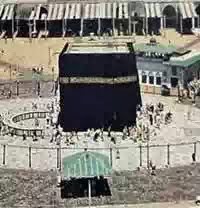
·Supplicating after stoning the bigJamarah.
·Some people think that they are actually stoning Satan and that he is
there physically, and start giving Satanic names to each of the
threeJamaraat. This is incorrect and is not permitted.
·Wasting the meat of the sacrificial animal after slaughtering it,
even though it is possible to distribute it amongst the poor.
·Running and uncovering the right shoulder )for men( duringTawaaf
Al-Ifaadhah, while this should only be done during the firstTawaaf.
·Some people push, shove and harm others in order to kiss the Black
Stone, they may even abuse others or hit them. This is not suitable
behavior for such a place, and Allaah The Almighty Says )what
means(:}Hajj is )during( well known months, so whoever has made hajj
obligatory upon himself therein )by entering the state of ihram(,
there is )to be for him( no sexual relations and no disobedience and
no disputing during Hajj{]Quran, 2: 197[
·Some people believe that the Black Stone benefits on its own and they
touch it with their hands then rub their bodies with them. This is
ignorance, because Allaah The Almighty alone is the One who benefits,
and 'Umar,said while he was touching it,"I know that you are merely a
stone which neither harms nor benefits, and had it not been that I saw
the Prophet,kissing you I would not have kissed you."
·Some people touch all corners of theKa'bah,and all four of its
walls.This is incorrect; theSunnah)Prophetic tradition( is to only
touch the corner which contains the Black Stone and Yemeni Corner.
·Kissing the Yemeni Corner when one is only supposed to touch it with
the hand if possible or else pass it without uttering"Allaahu Akbar"or
doing anything else.
·Some people commit to certain supplications duringTawaaf.
·Some people recite supplications aloud so that others can
collectively repeat after them. This is incorrect, because it disturbs
others around them and contradicts theSunnah.
·Some people push others in order to pray behind the station of
Ibraaheem.It is permissible to pray the twoRak'ahsafterTawaafanywhere
in the mosque.
·Some people recite the Quran for a long time during the
twoRak'ahsafterTawaaf, then raise their hands and supplicate.
·Some people performTawaafas a group while holding each other's hands,
thus make things extremely difficult for others trying to
performTawaaf.
·It is not permissible to go inside the semi-circular wall that begins
at the corner after the black stone, because this area is considered
as being inside theKa'bah. If this is done then one must repeat the
current circuit.
·Combining prayers in Mina.
·Not spending the night in Mina.
·Abandoning supplications after stoning the first twoJamaraat.
·Some people stone during times other than those designated for
stoning, which starts when the sun reaches its zenith.
·Some people think that they are actually stoning Satan and that he is
there physically, so they shout and scream. We must remember that this
rite was legislated so as to establish the remembrance of Allaah The
Almighty, and this is why the Prophet,, used to utter"Allaahu
Akbar"after each pebble.
·Supplicating after stoning the last one of the threeJamaraat.
·Some people do not stone the threeJamaraatin the correct sequence.
·Some people throw all pebbles at once, which is a serious mistake
that necessitates that they must re-throw, as the scholars have
said,"If someone throws all pebbles in one go, it will count as one
pebble only. One should throw only one pebble at a time."
·Some people authorise others to throw on their behalf whilst being
capable of doing it themselves, and this contradicts the command of
Allaah The Almighty for fulfilling the rites ofHajj.
·Some people authorise others to stone on their behalf and then return
to their countries without spending the nights in Mina during the days
ofTashreeq, and without stoning.
·Some people go from Minaon the day they are returning to their
countries of residence and perform the farewellTawaaf,they then return
to Mina and stone the last day's threeJamaraat.By doing so, they have
not made the farewellTawaafthe last act that they have performed.
Errors and Innovations in Hajj - I

assumeIhraam)the sacral state(.This is incorrect and should only be
done during theTawaaf)circumambulation( of arrival for'Umrah.
·Some people think thatIhraamis initiated by donning the clothes
ofIhraam, when in fact it is initiated by the intention in one's
heart. Therefore, wearing the clothes ofIhraamis actually the physical
preparation forIhraam.
·Some women mistakenly think that theirIhraamclothes should be of a
certain color, such as white or green, and this is incorrect. A woman
can wear her regular clothes, as long as they are within defined
Islamic limits, and she must avoid adornment or clothes that are tight
or transparent. This kind of garment is prohibited anyway at all
times.
·Men praying wearing the lower garment ofIhraamonly, which is wrong
because the Prophet,, said:"Let not any of you pray with a garment
which does not cover his shoulders."]Al-Bukhaari, Muslim[
·Shaving the beard when assumingIhraamis an act that is prohibited at all times.
·Some people believe that once they wear the clothes ofIhraamthey are
prohibited from removing them, even if they become dirty; when in fact
they can change or wash it.
·CollectiveTalbiyah.
·Combining the prayers in Mina when they are only permitted to shorten them.
·Not exerting extra effort in reciting the Quran and worshipping
Allaah The Almighty, when this is the place where they are supposed to
exert these extra efforts.
·Not spending the night in Mina on the night of the eighth
ofThul-Hijjahwithout a legitimate excuse.
·Some pilgrims choose a place to stay in without first finding out
whether they are inside or outside the boundary of 'Arafaatalthough
there are signs clearly indicating the boundaries of 'Arafaat.Standing
within the boundaries of 'Arafaat is a pillar without whichHajjis
incomplete; and the area calledWaadi 'Arunahis not within the
boundaries.
·Some people leave 'Arafaat before sunset, which is not permitted.
·Some people struggle to climb the mount, believing that it holds
certain virtues, which, according to them, makes it mandatory to climb
it - this has not been reported as being a practice of the Prophet,.
·Some people face the direction of the mountain of'Arafaatduring their
supplications, which is a mistake; theSunnah)Prophetic tradition( is
that they must face theQiblah.
·Some pilgrims waste time on that day in joking and idle chatter, and
abandoning supplications and the remembrance of Allaah The Almighty on
this great day.
·Many pilgrims take cameras and use them to shoot pictures of the
rituals, which is not what a pilgrim should be doing.
·Not making sure that the direction of the prayer is towards
theQiblahbefore prayingMaghrib, 'Ishaa'orFajr: it is compulsory to ask
anyone who knows the direction and to face it while praying.
·Some people collect their stones for stoning theJamaraatas soon as
they arrive in Muzdalifah and before offering
theirMaghriband'Ishaa'prayers, thinking that this is permitted. In
fact theSunnahis to collect them after leaving Muzdalifah as one heads
towards Mina, although it is permissible to collect the pebbles from
anywhere.
·Some people do not make sure that they are spending the night within
the boundaries of Muzdalifah.
·Delaying theMaghriband'Ishaa'prayer until after midnight: this is prohibited.
·Some people leave Muzdalifah before midnight without spending the
night there and without having a legitimate excuse; although this is a
compulsory rite ofHajj.
·Some people leaveMuzdalifah and head towards Mina even before
theFajrprayer, although they are strong and healthy and have no excuse
to leave early, as the weak or sick might.
·Staying up all night praying and remembering Allaah The Almighty, or
reciting the Qur'aan, which contradicts theSunnah.
·Delaying theFajrprayer close to sunset or later.
·Sleeping after prayingFajr.
·People rushing out with their cars harming others and perhaps even
causing accidents.
·Some people do not make sure whether their stones fall into the
stoning plate or not.
·Some people authorise others to stone on their behalf, which is only
permissible for people totally incapable of stoning due to sickness or
other valid reasons )such as for the elderly, women and children(.
·Some people use slippers or huge rocks to stone with.
·Some people say,"O Allaah! I stone to enrage Satan and please You."
To be continued …
Some Violations of Invocation - II

something in the religion that is not in it, his innovation will be
rejected."It is impermissible to innovate a certain way for invocation
and adhere to it or ask others to adhere to it. Some of these
innovations are:
•Collective invocation. Shaykh Ibn 'Uthaymeensaid, "Among the mistakes
that are committed by some pilgrims during Tawaaf )circumambulation(
is that they gather and assign a leader to lead them in Tawaaf and
dictate them invocation loudly and the entire group repeats after him.
Their voices get loud and chaos prevails. This distracts the rest of
the people performing Tawaaf and they lose track of what they are
saying. This drives away humbleness and harms the slaves of Allaah in
that safe place."
•Specifying some places or some times with certain invocations. It is
impermissible to specify a certain place or time with a certain
invocation unless there is a Sharee'ah )Islamic legislation( text for
this. The opinions of the scholars regarding the impermissibility of
specifying certain invocations for each turn in Tawaaf
)circumambulation( or Sa'y )going between As-Safa and Al-Marwah( were
previously mentioned. Shaykh Bakr Abu Zayd said, "Any one who
innovates any thing in Thikr and specified invocation that is not in
it deeming it as an act to be followed, will bear sin from four
perspectives:
1.Abandoning what is prescribed.
2.Modifying or correcting legislation.
3.Preferring what was not legislated.
4.Misleading people into thinking the permissibility of what he has done."
2.Obliviousness of the heart.Many people invoke Allaah The Almighty
with an oblivious heart as their mind is busy with other matters or
they do not contemplate the words that they are saying.
Shaykh-ul-Islam Ibn Taymiyyahsaid, "The origin of invocation is the
heart and the tongue is a follower of it. Thus, the one who
concentrates on correcting his tongue weakens his heart. This is why
the desperate one invokes Allaah with his heart with an invocation
that is not previously formulated. This is experienced by every
believer in his heart. Invocation may be in Arabic or any other
language as Allaah The Almighty knows the intention of the invoker
even if he does not correct his tongue, as Allaah knows the sounds of
voices however different the languages and the needs are."
Shaykh Ibn 'Uthaymeen said, "One of the mistakes that some of those
who perform Tawaaf make, is that they take the written invocations and
say them without knowing their meanings. These invocations may include
mistakes done by the publisher that change the meaning totally and
turn it to be supplication against the person. Hence, he may
supplicate against himself without knowing that he is doing so. We
have heard many such strange stories."
3.Being impatient with the answer.Abu Hurayrahnarrated that the
Prophetsaid: "The invocation of anyone of you is granted )by Allaah(
if he does not show impatience )by saying, 'I invoked Allaah but my
request has not been granted.'" ]Al-Bukhaari and Muslim[
It is the duty of Muslims to invoke Allaah The Almighty a lot and ask
Him to accept their invocation. They should utilize the possible means
for the acceptance of invocation while applying the etiquettes of
invoking Allaah The Almighty and observing the times during which
invocation is accepted. Muslims should repent to Allaah The Almighty
and abandon sins and acts of disobedience, and ask Allaah The Almighty
for forgiveness as the one who keeps trying would ultimately achieve
his aim. 'Urwah bin Az-Zubayrused to maintain his daily invocations
just as he maintained reciting his daily quota of the Quran. Muwarriq
Al-'Ijli said, "I invoked my Lord for something for twenty years and
it was not achieved, but I did not feel desperate."
It was reported that Abu Ja'far Muhammad bin 'Ali and Adh-Dhahhaak
said that there were forty years between the invocation and its
acceptance in the verse in which Allaah The Almighty says )what
means(:}]Allaah[ said, "Your supplication has been answered."{]Quran
10:89[
Pilgrims should know that they have the honor of the place, time and
deed as they are in the most honorable place on earth, and on the best
days and the most loved by Allaah The Almighty. Moreover, they are
performing one of the most honorable and elevated deeds, so they
should seize this great opportunity to invoke Allaah The Almighty,
resort and submit to Him as they do not know whether they would have
this chance once more or not.
Some Violations of Invocation - I
Muslims were ordered to avoid during invoking Allaah The Almighty
according to Sharee'ah )Islamic legislation( texts. Some of these
matters are:
1. Invoking any other than Allaah The Almighty.This is one of the
greatest violations as invoking any other than Allaah is major Shirk
)polytheism( that Allaah The Almighty does not forgive the slave for,
if he dies without repenting. Shaykh-ul-Islam, Ibn Taymiyyahand others
said that whoever makes mediators between himself and Allaah The
Almighty whom he invokes is considered a disbeliever by consensus.
Ibn Al-Qayyimsaid, "One of the types of major Shirk is to invoke the
dead and seek their help. This is the origin of Shirk in the world as
the dead can neither bring harm nor benefit to his own self or to any
one who seeks his help or asks for his intercession. This is done out
of ignorance of the one who should intercede and the One before whom
this intercession is made for him."
Shaykh Ahmad bin 'Eesa said, "It was established that invocation
combines many types of worship such as submitting one's face to the
one who is invoked, relying on him as well as submission and humbling
oneself. Whoever submits his face to any other than Allaah is a
polytheist whether he acknowledged it or not."
Despite the danger of this matter, you find people who belong to Islam
yet they invoke other than Allaah The Almighty. Those people might say
while they are at the sacred mosque or while performing Tawaaf
)circumambulation(: "O Muhammad!", "O 'Ali!", "O Husayn!", "Madad
Madad Ya Badawi!", "O 'Abd Al-Qaadir!" or "O 'Aydaroos!" These forms
of invocations are among the forms of invoking other than Allaah The
Almighty. Muslims should avoid invoking any other than Allaah The
Almighty in order to preserve their religion and Tawheed )Islamic
Monotheism(. They should also disapprove of the ones who invoke other
than Allaah The Almighty.
2.Supplicating Allaah The Almighty by means of prophets or righteous
people is one of the Bid'ahs that many Muslims commit.When invoking
Allaah The Almighty, some Muslims say, "O Allaah! I invoke you by
means of the status of your Prophet Muhammad," or "By means of the
status of your righteous slaves." This form of invocation is
innovated, as it did not take place at the time of the Prophetthe
rightly guided Caliphs or the righteous predecessors. Shaykh-ul-Islam
Ibn Taymiyyahsaid that invoking Allaah The Almighty by means of the
status of the dead is a Bid'ah according to the consensus of Muslims.
Shaykh Ibn Baazsaid,
"There is one type that is called Tawassul )intercession(, which is
invoking Allaah by means of the status of the Prophetor by his right
or self. For instance, one might say, 'O Allaah! I invoke you by means
of your Prophet, or by his status, or by means of the status of your
prophets or their right, or by means of the status of the righteous
people and so forth. This is Bid'ah )innovation( and leads to Shirk
)polytheism(. Invoking Allaah by means of any other is impermissible
whether this was by means of the Prophetor by any other person, as
Allaah The Almighty did not legislate this and acts of worship are
determined by Sharee'ah )Islamic legislation( texts with no room for
human reasoning."
Thus, there are other kinds of lawful Tawassul that are permissible
because of being proved by Sharee'ah texts. These are:
•Tawassul through the Names, Attributes and Deeds of Allaah.
•Tawassul through one's good deeds.
•Tawassul through the invocation of the righteous people.
3.Transgressing in invocation. Allaah The Almighty says )what
means(:}Call upon your Lord in humility and privately; indeed, He does
not like transgressors.{]Quran 7:55[ Shaykh-ul-Islam Ibn
Taymiyyahsaid, "Transgression may occur by the multiplicity of
expressions or meanings." Shaykh Bakr Abu Zayd said, "This includes
forbiddance of any type of transgression in invocation and among what
is included here is the innovation in supplication either with regard
to time, place, quantity or way of performance."
'Abdullaah bin Mughaffalsaid that he heard his son saying, "O Allaah!
I ask you to grant me the white palace on the right side of Paradise."
He said to him, "O son! Ask Allaah to grant you Paradise and seek
refuge with Him from Hell as I heard the Prophetsaying:"There will be
people in this Ummah who transgress in purification and
invocation."]Abu Daawood and Ibn Maajah[
One of the sons of Sa'd bin Abi Waqaassaid, "My father heard me
saying: 'O Allaah! I ask you to Grant me Paradise, its bliss, its
delight and such and such, and I seek refuge with you from Hell, its
chains and shackles and such and such.' Thus, he told me, 'O son! I
heard the Prophetsaying:'There will be people who transgress in
invocation.'Be wary of being one of them. If you were given Paradise,
you will be granted it along with all the good therein and if you were
saved from Hell you will be saved from it and all the evils therein."
]Abu Daawood[
Among the transgression in invocation are the following:
•Detailing in invocation
•Invoking Allaah The Almighty for a sin or for severing of kinship ties.
•Making invocation conditional like saying, "O Allaah! Forgive me if You wish".
•Exclusion in invocation. An example of this is what a Bedouin said,
"O Allaah! Have mercy upon me and Muhammad, and do not have mercy upon
any other one."
•Invoking Allaah The Almighty for something that is predetermined.
•Exaggeration in making rhyme in invocation.
•Exaggeration in raising the voice with invocation.
Dought & clear, - Sending blessings upon the Prophet (blessings and peace of Allaah be upon him) when he is mentioned in obligatory and naafil prayers.

of the Prophet (blessings and peace of Allaah be upon him), should you
send blessings upon him because of mentioning him, or is sending
blessings upon him not among the actions of prayer except at the
appropriate point in the Tashahhud, so it should only be done then and
not at any other point?.
Praise be to Allaah.
In the obligatory prayer, that should not be done, because there is no
report of that from the Prophet (blessings and peace of Allaah be upon
him). But in the naafil prayer, there is nothing wrong with it,
because when he (blessings and peace of Allaah be upon him) prayed
tahajjud at night, he would pause at every verse in which Allaah was
glorified and glorify Him, and at every verse that mentioned seeking
refuge with Allaah and seek refuge with Him, and at every verse that
mentioned asking and ask of Him. Sending blessings upon him (blessings
and peace of Allaah be upon him) falls into the same category.
And Allaah is the source of strength.
Dought & clear, - Commentary on the hadeeth, “No one who has an atom’s weight offaith in his heart will enter Hell”

heart will enter Hell, and that the one who has an atom's weight of
arrogance in his heart will enter Paradise. Is this true?
Praise be to Allah.
What is indicated by the texts of the Qur'an and Sunnah, and the
consensus of the early generations of this ummah is that no one who
has an atom's weight of faith in his heart will abide in Hell for
eternity. If a Muslim who was a sinner died without repenting from his
sin, then his case will be decided by Allah: if He wills He will
pardon him, and if He wills He will punish him, but he will not abide
in Hell forever in any case.
Al-Bukhaari (44) and Muslim (193) narrated from Anas that the Prophet
(blessings and peace of Allah be upon him) said: "Whoever says Laa
ilaaha ill-Allah and has in his heart goodness the weight of a grain
of barley will be brought out of Hell, then whoever says Laa ilaaha
ill-Allah and has in his heart goodness the weight of a grain of wheat
will be brought out of Hell, then whoever says Laa ilaaha ill-Allah
and has in his heart goodness the weight of an atom (or a small ant)
will be brought out of Hell."
This idea is repeated in other hadeeths, the wording of which is similar.
With regard to your saying that no one who has an atom's weight of
faith in his heart will enter Hell, this is also proven, but some of
the scholars interpret it as meaning that such a one will not enter it
as the disbelievers do, i.e., he will not abide therein for eternity,
although he will may enter it. Thus this hadeeth may be reconciled
with the many texts that say that some of the sinners among the
believers will enter Hell even though they have faith in their hearts,
then they will be brought out by means of intercession and so on.
At-Tirmidhi (1999), Abu Dawood (4091) and Ibn Maajah (59) narrated
from 'Abdullah ibn Mas'ood that the Prophet (blessings and peace of
Allah be upon him) said:"No one will enter Paradise in whose heart is
an atom's weight of arrogance and no one will enter Hell in whose
heart is an atom's weight of faith." A man said: What if I like my
clothes to look nice and my shoes to look nice? He said: "Verily Allah
loves beauty; rather arrogance means rejecting the truth and looking
down on people."
Classed as saheeh by al-Albaani in Saheeh at-Tirmidhi.
Imam at-Tirmidhi (may Allah have mercy on him) said, after quoting
this hadeeth: Some of the scholars said, commenting on this hadeeth,
that no one who has an atom's weight of faith in his heart will enter
Hell; the only meaning is that they will not abide in the Fire
forever. This was narrated from Abu Sa'eed al-Khudri from the Prophet
(blessings and peace of Allah be upon him) who said: "Everyone in
whose heart there is an atom's weight of faith will be brought out of
Hell." More than one of the Taabi'een interpreted the verse
(interpretation of the meaning), "Our Lord! Verily, whomever You admit
to the Fire, indeed, You have disgraced him" [Aal 'Imraan 3:192] as
meaning: whomever You cause to abide forever in the Fire, indeed, You
have disgraced him. End quote.
With regard to the second sentence, in which you say, "that the one
who has an atom's weight ofarrogancein his heart will enter Paradise",
this is also proven, as in the hadeeth quoted above. It was quoted by
Muslim (91), with this sentence only, from 'Abdullah ibn Mas'ood from
the Prophet (blessings and peace of Allah be upon him) who said:"No
one will enter Paradise in whose heart is an atom's weight of
arrogance." A man said: What if a man likes his clothes to look nice
and his shoes to look nice? He said: "Verily Allah is Beautiful and
loves beauty; arrogance means rejecting the truth and looking down on
people."
What this hadeeth means is that no one will enter Paradise without
being exposed to the possibility of requital or punishment; he may be
punished or he may be pardoned, unlike the obedient believer who is
free of this major sin, who will enter Paradise without being exposed
to the possibility of entering Hell.
An-Nawawi (may Allah have mercy on him) said inSharh Muslim: Rather
the apparent meaning is that which was favoured by al-Qaadi 'Iyaad and
other scholars, which is that he will not enter Paradise without
bringing him to account and punishing him if He wills, or He may let
him off. Rather it is inevitable that all of those who affirm the
Oneness of Allah will enter Paradise, either initially or later on,
after some of those who committed major sins and died whilst
persisting in them have been punished. And it was said that he will
not enter Paradise with the pious in the first group to enter.
End quote.
To sum up:
What you asked about is the text of one or two saheeh hadeeths, the
meaning of which is as we have said. It is not correct for anyone to
imagine that it is impossible for the one who has an atom's weight of
faith in his heart to enter Hell no matter what major sins he has
committed, and he should not imagine that it is impossible for the
Muslim in whose heart there is an atom's weight of arrogance to enter
Paradise, no matter how great his faith.
Two groups of people did not understand these texts corectly, the
Khaarijis and the Murji'ah. The Khaarijis focused only on the texts
that contain the warning, such as the second hadeeth, and the Mujri'ah
focused only on the texts that contain the promise, such as the first
hadeeth. But Allah guided Ahl as-Sunnah wa'l-Jamaa'ah to the correct
view, which reconciles between the texts.
And Allah knows best.
Subscribe to:
Comments (Atom)